

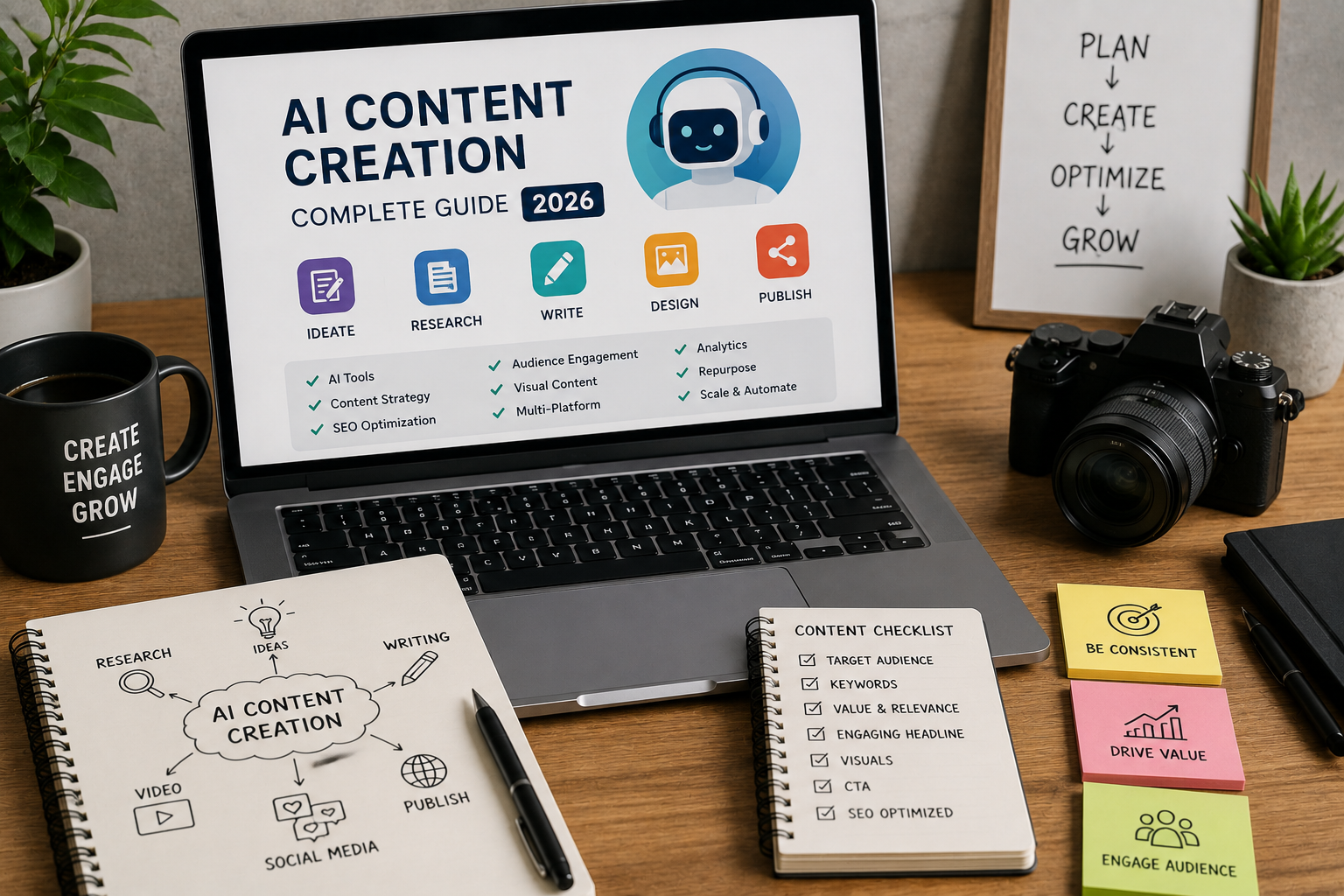
Artificial Intelligence has completely changed how businesses create content. In 2026, AI content creation is no longer optional — it’s a core part of every successful digital marketing strategy. From blog writing to video scripts, AI tools now help creators produce high-quality content faster, smarter, and at scale.
This guide breaks down everything you need to know about AI content creation in 2026 — tools, strategies, SEO best practices, and what’s coming next.
What Is AI Content Creation?
AI content creation refers to using artificial intelligence tools to generate, optimize, or assist in producing content such as:
- Blog posts and articles
- Social media captions and ads
- Product descriptions
- Video scripts and voiceovers
- Images, graphics, and infographics
- Email and marketing copy
Modern AI tools use large language models (LLMs) trained on massive datasets to understand context, tone, and search intent — making content creation faster without sacrificing quality when used correctly.
Why AI Content Creation Matters in 2026
1. Speed and Scale
Businesses can now produce weeks of content in hours. This is critical for brands managing multiple websites, landing pages, or client campaigns.
2. Search Engines Now Reward Helpful AI-Assisted Content
Google and other search engines have shifted focus from “who wrote it” to “how helpful and accurate it is.” AI content that follows E-E-A-T (Experience, Expertise, Authoritativeness, Trustworthiness) principles still ranks well.
3. Rise of AI SEO and Answer Engines
With tools like Google AI Overviews, ChatGPT, and Gemini becoming primary information sources, businesses need content optimized not just for search engines but for AI answer engines too. This is often called AI SEO or Generative Engine Optimization (GEO).
4. Cost-Effective Content Production
AI reduces content production costs significantly, allowing small businesses and agencies to compete with larger brands on content volume and consistency.
Top AI Content Creation Tools in 2026
| Tool Category | Popular Tools | Best Use Case |
| Text/Blog Writing | ChatGPT, Claude, Jasper | Long-form articles, blogs |
| SEO Content Optimization | Surfer SEO, Frase, Clearscope | Keyword optimization, content scoring |
| Image Generation | Midjourney, DALL·E, Canva AI | Blog images, social graphics |
| Video Content | Synthesia, Pictory, InVideo AI | Explainer videos, reels |
| Social Media | Buffer AI, Ocoya | Captions, scheduling, hashtags |
How to Create SEO-Optimized Content Using AI (Step-by-Step)
Step 1: Keyword Research First
Always start with proper keyword research using tools like Google Keyword Planner, Ahrefs, or SEMrush. AI writing tools work best when given clear target keywords and search intent.
Step 2: Use AI for the First Draft
Let AI generate the structure and first draft based on your keywords, outline, and target audience.
Step 3: Add Human Expertise and Facts
Insert real data, personal insights, case studies, and examples. This builds trust and satisfies Google’s E-E-A-T guidelines.
Step 4: Optimize On-Page SEO
- Use the focus keyword in the H1, first 100 words, and at least one H2
- Add meta title and meta description
- Use internal and external links
- Optimize images with alt text
- Keep URL slugs short and keyword-rich
Step 5: Edit for Readability and Accuracy
AI can generate factual errors (“hallucinations”). Always fact-check before publishing.
Step 6: Add Schema Markup
Use FAQ schema, Article schema, or How-To schema to help search engines and AI tools understand your content better.
AI Content Creation Best Practices for 2026
- Don’t publish 100% AI content without editing — Google’s helpful content guidelines still prioritize originality and expertise
- Mix AI speed with human creativity — use AI for research and drafts, humans for storytelling and brand voice
- Optimize for AI search engines — write clear, structured answers that AI Overviews and chatbots can easily extract
- Update old content using AI — refresh outdated blog posts to keep them ranking
- Use AI for content repurposing — turn one blog into social posts, videos, and email newsletters
Common Mistakes to Avoid
- Publishing unedited, robotic-sounding AI content
- Ignoring keyword intent and search behavior
- Skipping fact-checking on AI-generated statistics
- Not adding original images or brand elements
- Forgetting internal linking, which hurts site authority and navigation
The Future of AI Content Creation
By the end of 2026, expect deeper integration of AI across:
- Voice and conversational search optimization
- Personalized content generation based on user behavior
- AI-powered content audits that suggest real-time SEO improvements
- Multimodal content — combining text, image, and video generation in a single workflow
Businesses that combine AI efficiency with human expertise, proper SEO structure, and authentic brand voice will dominate search rankings in the coming years.
Final Thoughts
AI content creation in 2026 isn’t about replacing writers — it’s about working smarter. The brands that win will be the ones that blend AI speed with human insight, strong SEO fundamentals, and genuine value for readers.
Need expert help building an AI-powered SEO content strategy for your business? SEO Company India specializes in AI SEO, content marketing, and website optimization to help your brand rank higher and convert better. Digital Marketing Company India to get started.